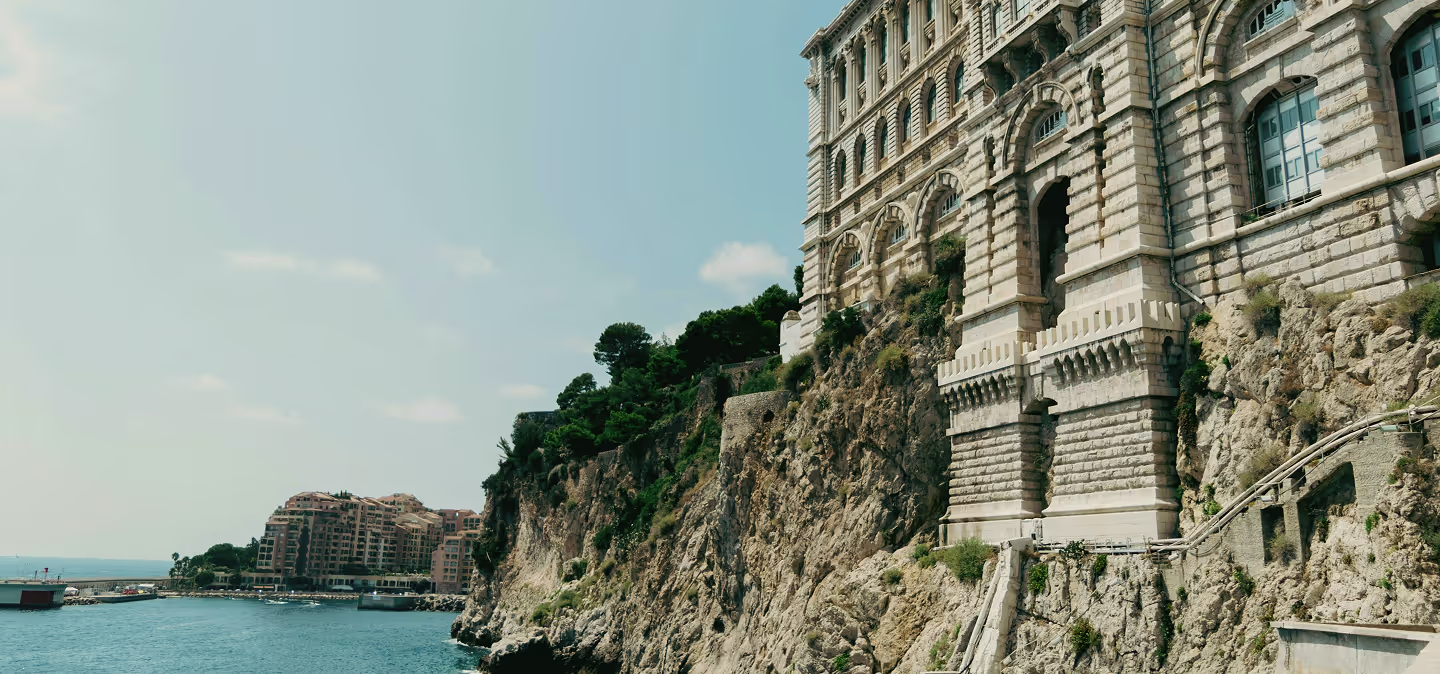
An hour by train from Monaco, Cap d'Antibes combines a spectacular coastal path, one of the most powerful lighthouses in the Mediterranean and gardens open to the public. The complete guide to the peninsula.
Cap d'Antibes covers barely a few square kilometres, yet it holds almost everything that built the legend of the French Riviera: a coastal path lashed by sea spray, a lighthouse whose beam carries sixty kilometres out to sea, villas hidden behind tall stone walls and a fine sand beach that became famous back in the 1920s. An hour by train from Monaco, this wooded peninsula is the exact opposite of the crowded seaside resorts nearby.
This guide gathers what you need to know before you go: the route of the Tirepoil coastal path, the gardens of Villa Eilenroc, access to the Garoupe plateau, which beach to choose and the easiest way to get there from the Principality.
What exactly is Cap d'Antibes?
A peninsula between Antibes and Juan-les-Pins
Cap d'Antibes is a wooded peninsula reaching into the Mediterranean between the old town of Antibes to the east and Juan-les-Pins to the west. Administratively it belongs to the town of Antibes Juan-les-Pins. Geographically it works as a world of its own: pine groves, private lanes, rocky coves and a single plateau rising to around 75 metres.
The southern tip of the peninsula sits within the Natura 2000 site « Baie et cap d'Antibes - îles de Lérins ». Part of the shoreline belongs to the Conservatoire du Littoral, which is why the coastal path has remained open to walkers despite the value of the estates lining it.
Who lives on Cap d'Antibes?
Since the middle of the 19th century the peninsula has drawn wealthy owners who built vast residences here. Château de la Garoupe dates from 1907 and Château de la Croë from 1927, the latter home for a time to the Duke of Windsor and Wallis Simpson after the abdication.
Cap d'Antibes remains one of the most sought-after residential addresses on the Riviera. Most houses are invisible from the road, screened by walls and pines. Only Villa Eilenroc, bequeathed to the town, can be visited. That deliberate discretion gives the peninsula a character quite unlike that of Saint-Jean-Cap-Ferrat, its neighbour across the bay.
The Tirepoil path, the finest walk on Cap d'Antibes
Starting point, duration and difficulty
The coastal path, known locally as the Sentier de Tirepoil, follows the southern tip of the peninsula. Its name comes from the wind that blows almost constantly along this stretch of coast and pulls at walkers' hair.
The walk starts from the large car park on avenue André Sella, near La Garoupe beach. Two hundred metres are enough to leave the built-up area behind: after that there is nothing but the sea, the wind and the gulls. The Antibes tourist office allows around two hours for the walk. The path alternates level stretches with steps cut into the rock. There is no technical difficulty, but proper closed shoes are essential.
What you see along the customs officers' path
The walk moves from one set piece to the next. You first pass below Château de la Garoupe, hidden behind a long stone wall and a pine grove. The belvedere then offers one of the finest viewpoints on the French Riviera: in calm seas, dolphins are a regular sight.
The vegetation alone justifies the trip. Rock samphire, silver ragwort, sea lavender and the endemic Jupiter's beard have all adapted to what looks like a hostile environment. At the foot of the cliff, a posidonia meadow testifies to the quality of the water. Just before the belvedere the rock changes shape and colour, taking on an almost lunar look, a reminder of the region's volcanic past.
The final section runs alongside Villa Eilenroc, then climbs back via avenue Mrs L. D. Beaumont and avenue de la Tour Gandolphe.
Rules to know before setting off
- The path closes in bad weather, particularly during gales. Check the marine forecast before you go.
- The site is protected: stay on the marked path, pick nothing, leave nothing behind.
- Bring water. There is no refreshment point anywhere along the route.
- Avoid flip-flops and smooth soles, the rock is slippery in places.
- The Antibes Juan-les-Pins tourist office runs guided nature walks along the path.
♦ Concierge's tip
Walk the Tirepoil path from La Garoupe beach towards Villa Eilenroc, and start early: the sun is then behind you for the whole first half of the route, which changes everything for photographs and for keeping cool. Staying at Port Palace, your concierge can set the train time from Monaco-Monte-Carlo and check that the path is actually open on the day of your outing.
The Garoupe plateau: lighthouse, chapel and orientation table
The Garoupe lighthouse
Perched at the top of the plateau, the Garoupe lighthouse stands 103 metres above sea level. With a light intensity of more than 2,300,000 candelas, it is one of the most powerful lighthouses on the Mediterranean coast: its beam reaches up to 60 kilometres at sea and as far as 100 kilometres from the air. It reopened to visitors in 2024, with hours that vary by season. Check before making the climb.
The plateau is reached by road or on foot along the Chemin du Calvaire. An orientation table helps decipher the panorama: on a clear day the view stretches from Italy to Cap Camarat, with the snow-covered Alps to the north and, very early in the morning, the mountains of Corsica to the south.
The Notre-Dame-de-la-Garoupe chapel
At the foot of the lighthouse, the Notre-Dame-de-la-Garoupe chapel holds a remarkable collection of maritime ex-votos, left over the centuries by sailors who made it safely home. Listed and still consecrated, it reopened after two years of restoration work. Its peculiarity lies in its two naves, each with its own Madonna.
On the plateau, a small oratory designed by Raymond Peynet, creator of the famous Lovers, adds an unexpected note. The Bistrot du Curé serves local specialities in the shade of the pines, from pan bagnat to pissaladière.
The Garoupe woods
Just below, the Garoupe woods spread 9 hectares of holm oak owned by the Conservatoire du Littoral. Open all year round, they make a shaded alternative to the coastal path on very hot days.
☉ Good to know
The Garoupe plateau brings together a lighthouse, a chapel, a French navy semaphore station and telecommunications relays. Visiting hours for the lighthouse and the chapel vary by season and by religious services. Check with the Antibes Juan-les-Pins tourist office before climbing up, especially out of season.
Villa Eilenroc and its gardens
A house named after an anagram
In the 1860s a wealthy Dutchman named Hugh Hope Loudon bought land on Cap d'Antibes to build a mansion he called Eilenroc, an anagram of Cornélie, his wife's name. At the time the plot was little more than scrubland.
In 1873 the property passed to James Wyllie, who commissioned an exceptional garden. In 1927 the American couple Mr and Mrs Beaumont acquired it and asked landscape architect Jacques Gréber to redesign the park. The Beaumonts threw parties that became legendary on the Riviera. In 1982 Mrs Beaumont bequeathed the estate to the town of Antibes Juan-les-Pins, on the express condition that the gardens remain open to the public.
The rose garden, the olive grove and the park
The park sits some thirty metres above the sea and offers an uninterrupted view over the bay. The rose garden pays tribute to a forgotten local tradition: Antibes was long considered the rose capital of France, and most of the varieties shown here were created on site.
The olive grove has a touching story of its own. In the year 2000, fifty olive trees were planted in honour of the children born that year. A first batch of olive oil has since been bottled.
How to visit the gardens
According to the Antibes tourist office, the gardens of Villa Eilenroc are open on Saturdays from 10am to 5pm. Opening days and times for the villa itself vary by season and by source: a phone call to the tourist office before travelling avoids disappointment, especially as private events lead to occasional closures.
Which is the best beach on Cap d'Antibes?
La Garoupe beach
La Garoupe beach is the best known on the peninsula and one of the few stretches of fine sand in the area, set in a cove sheltered from the west wind. This is where the French Riviera invented summer bathing in the 1920s, at a time when fashion still dictated that the coast be visited only in winter.
In practice the beach is divided between private beach clubs and fairly limited public sections. In July and August you need to arrive early in the morning to secure a decent spot on the public side. Out of season the place recovers a remarkable calm.
Billionaires' Bay
On the eastern side of the peninsula, Billionaires' Bay lines up a series of rocky coves at the foot of the great estates. For a long time reachable only by boat, it can now be accessed on foot via a path.
Know what to expect: this is pebbles and rock, with no facilities at all, no bins, no bar, no toilets. You come for the clear water and the setting, not for comfort. Anse de l'Argent Faux, in the same sector, is a good spot for watching seabirds.
The coves along the path
Several small coves along the Tirepoil path allow an improvised swim in calm seas. None are supervised or equipped, so caution is essential, especially once the swell picks up. Anyone who prefers a sun lounger and waiter service by the water will find it at the beach clubs of Monaco, or among the beaches of the Principality and its surroundings.
Beaches and coves of Cap d'Antibes
| Site | Shoreline | Facilities | Best for |
|---|---|---|---|
| La Garoupe beach | Fine sand, sheltered cove | Private beach clubs and limited public sections, dining nearby | Families, a full day out |
| Billionaires' Bay | Pebbles and rock | None: no toilets, no bar, no bins | Confident swimmers, photographers |
| Anse de l'Argent Faux | Rock and small pebbles | None | Seabird watching, quiet |
| Coves along the Tirepoil path | Rock | None, unsupervised swimming | An improvised swim in calm seas |
None of these coves is supervised. Give up on swimming as soon as the swell picks up.
The Villa Thuret botanical garden
Less busy than Villa Eilenroc, the Villa Thuret botanical garden is well worth the detour. Created in 1857, this English-style acclimatisation garden brings together more than 2,400 exotic plants. Bequeathed to the French state in 1878, it now falls under INRAE, which continues scientific work there on how species adapt to the Mediterranean climate.
Entry is free for individual visitors. The garden opens on weekdays, from 8am to 6pm between April and October and from 8.30am to 5.30pm between November and March, and closes on Saturdays, Sundays and public holidays. Group visits must be booked in advance.
How to get to Cap d'Antibes from Monaco
By train
The train remains the simplest option. From Monaco-Monte-Carlo station, five minutes on foot from Port Palace, allow around fifty minutes to Antibes station, with frequent departures throughout the day. From Antibes station, a local bus or a taxi reaches La Garoupe in about fifteen minutes. Our guide to getting to Monaco sets out the rail connections along the Riviera.
By car
By car, allow roughly an hour from Monaco via the A8, outside peak hours. Parking is the real issue: the car park on avenue André Sella, at the start of the path, fills up very quickly in summer. Arriving before 9am in July and August changes the whole experience of the day.
Getting around on site
Cap d'Antibes is best explored on foot. Distances between the Garoupe plateau, the beach and Villa Eilenroc are manageable, but the lanes are narrow and often have no pavement, so stay alert. Guests who would rather avoid driving and parking opt for a private transfer arranged from the hotel, a service detailed on our services page.
Cap d'Antibes: the essentials at a glance
| Location | Peninsula of the town of Antibes Juan-les-Pins, between Antibes and Juan-les-Pins |
| From Monaco | About 50 min by train to Antibes station, then 15 min by bus or taxi. Around 1 h by car via the A8 |
| Tirepoil path | Starts from the avenue André Sella car park. About 2 h walking. Free access, closed in bad weather |
| Garoupe plateau | Around 75 m altitude, lighthouse at 103 m. Reached by road or by the Chemin du Calvaire |
| Villa Eilenroc gardens | Open Saturdays 10am to 5pm according to the tourist office. Check before travelling |
| Villa Thuret botanical garden | Free for individual visitors, open on weekdays, closed weekends and public holidays |
| What to bring | Closed shoes, water, sun protection and a windbreaker |
Opening hours and access conditions are indicative, checked with the Antibes Juan-les-Pins tourist office and INRAE in August 2026. They may change.
Cap d'Antibes in the morning, Port Hercule at sunset: one hour by train separates the two.
Check availabilityWhen is the best time to visit Cap d'Antibes?
Spring is probably the finest season: the vegetation along the path is in flower, the light is sharp and the car parks remain accessible. May and June combine pleasant temperatures with moderate crowds.
In July and August the peninsula is busy and the heat makes the path demanding in the middle of the day. An early morning outing, before 10am, remains very enjoyable. Autumn offers a fine window: the sea is still warm in September and the path recovers its calm from mid-October.
Winter should not be ruled out. On a clear day the view from the Garoupe plateau reaches the snow-covered Alps, and the path takes on a wild quality that summer denies it. You simply have to accept the wind that gave the path its name.
A day on Cap d'Antibes from Port Palace
The peninsula lends itself perfectly to a day trip from Monaco. Leaving by train around 9am leaves time to walk the Tirepoil path in the morning, have lunch near La Garoupe beach, then climb to the plateau in the early afternoon, when the light begins to settle over the bay.
Back in Monaco in late afternoon, with time to enjoy the view over Port Hercule from our rooms and suites facing the harbour. For dinner, the terrace of La Môme restaurant on the sixth floor is a natural way to round off a day spent by the sea.
Those with more time can string together other Riviera escapes: the village of Èze perched between sky and sea, or Roquebrune-Cap-Martin and its own coastal path, minutes from the Principality.
Port Palace Monaco
Monaco as your home port, the Riviera as your playground
Fifty rooms and suites facing Port Hercule, five minutes on foot from Monaco-Monte-Carlo station. Our guests benefit from a concierge service to arrange private transfers, excursions and reservations, from Cap d'Antibes to the hilltop villages inland.
Book your stayFrequently asked questions about Cap d'Antibes
Is the Cap d'Antibes coastal path free?
Yes. The Tirepoil path is a public right of way, freely accessible all year round and with no ticket. It closes only in bad weather, particularly during gales. Parking at the start, on avenue André Sella, is also free but limited in the number of spaces.
How long does it take to walk around Cap d'Antibes?
The Antibes tourist office allows around two hours for the coastal path, photo stops included. Adding the climb to the Garoupe plateau and a visit to the Villa Eilenroc gardens, you should count on a full day to cover the main sights.
Can you visit Villa Eilenroc?
The gardens can be visited, on Saturdays from 10am to 5pm according to the Antibes tourist office. Access conditions for the villa itself vary by season and by the private events held on site. Calling the tourist office beforehand is strongly advised.
Is Cap d'Antibes worth the trip from Monaco?
Yes, provided you give it at least half a day. The train journey takes around fifty minutes from Monaco-Monte-Carlo and the Tirepoil path ranks among the finest coastal routes on the French Riviera, with no direct equivalent in the Principality.
Which is the best beach on Cap d'Antibes?
La Garoupe beach remains the benchmark for its fine sand and sheltered cove, with a public section and private beach clubs. Those who prefer wild coves will favour Billionaires' Bay, more secluded but entirely without facilities.
In short
Cap d'Antibes is one of the rare stretches of the French Riviera where the beauty of the coast remains freely accessible, on foot, with no booking and no queue. A path, a lighthouse, a chapel, a few gardens and some coves: the programme sounds modest, and it easily fills a day.
From Monaco the excursion is straightforward. Staying at Port Palace, your dedicated concierge can set the train times, arrange a private transfer and point you to the best window for avoiding the crowds on the path.
