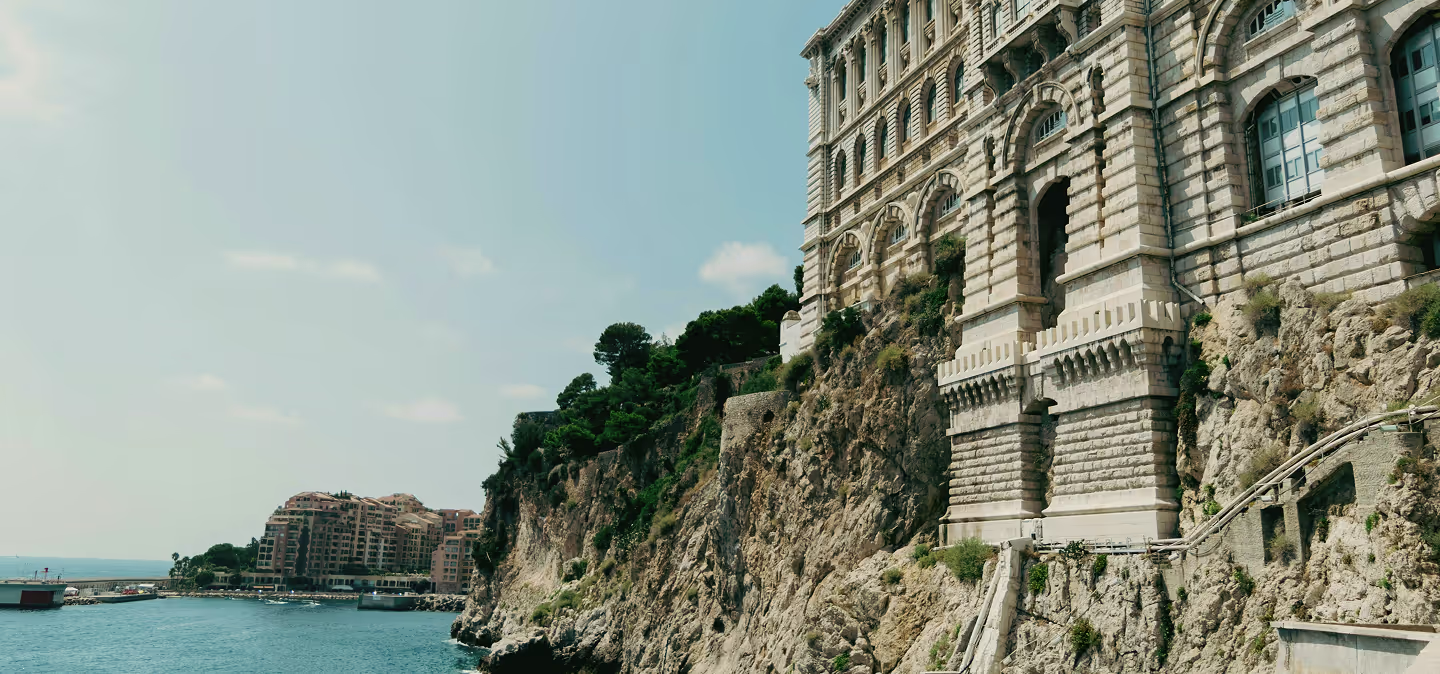
Discover Roquebrune-Cap-Martin, a medieval gem 5 km from Monaco: Carolingian castle, thousand-year-old olive, Le Corbusier coastal path, hidden beaches and insider tips from the Port Palace.
Just five kilometres from the Port Hercule, Roquebrune-Cap-Martin stretches between sea and mountain in a setting few towns on the Riviera can match. On one side, a medieval village clinging to a rocky outcrop 300 metres above the sea, crowned by the oldest keep in France. On the other, a cape blanketed in umbrella pines where Le Corbusier spent his last summers. In between, hidden coves and beaches that you would never guess existed from the Basse Corniche above. Our concierge regularly sends our guests there for the day. Here is what you need to know to visit Roquebrune-Cap-Martin without missing a thing.
♦ Concierge's Tip
From the Port Hercule, the most immersive way to reach Roquebrune-Cap-Martin is the coastal path. Allow 2.5 hours of leisurely walking; the panorama makes every step worth it. For a flexible day out, take the train one way (7 minutes) and walk back, ending with a swim at the Buse beach at sunset.
Roquebrune-Cap-Martin: a village suspended between sea and mountain
Roquebrune-Cap-Martin owes its character to a rare geography. The town occupies a narrow ribbon of land between the Mediterranean and the Mont Agel massif, stretching nearly 9 kilometres between Monaco and Menton. It actually combines two very different settings: the old village of Roquebrune, perched on its rocky spur high above the sea, and the leafy peninsula of Cap-Martin, lined with Belle Époque villas and century-old pines.
A unique geography on the French Riviera
The village stands at 300 metres in altitude, making it one of the most striking viewpoints on the Riviera. From its panoramic terrace, the eye sweeps from Monaco in the west to Cap-Martin and Italy in the east, taking in the entire bay of Menton. The contrast with Cap-Martin, almost entirely flat and wooded, gives the town its dual personality: rocky and vertical at the top, green and horizontal below.
A thousand years of history right next door to Monaco
Roquebrune was founded around 970 by Conrad I, count of Vintimille, to defend the coast against Saracen raids. The castle and its keep, built at that time, are the oldest still standing in France. The town long belonged to the Principality of Monaco before joining France in 1861 under Napoleon III, at the same time as Menton. The hyphen between Roquebrune and Cap-Martin came later, in 1921, to distinguish the town from the other Roquebrunes of Provence.
Visiting the old village of Roquebrune and its medieval castle
The old village is the most popular attraction in the town. Its vaulted alleys, covered passages and houses pinned to the rock make it one of the finest examples of a medieval hilltop village in the region, comparable to Èze but with fewer tourist shops and more year-round residents.
The Roquebrune Castle, oldest keep in France
The Carolingian castle of Roquebrune dates from the late 10th century. Its foundations go back to 970, making it one of the very few witnesses to pre-feudal military architecture in Europe. The keep, restored in the early 20th century by Sir William Ingram, can be visited from the basement up to the rooftop terrace. The climb is via a narrow spiral staircase, but the reward is total: the view from the top stretches from the Estérel to the Italian Riviera.
Entry is paid (around 5 euros, reduced rate for students and seniors). The castle is open daily during the season, with shorter hours in winter. Allow 30 to 45 minutes for the full visit.
The thousand-year-old olive tree, witness to 2000 years of history
A few steps from the castle, an impressive olive tree stands at the heart of a public garden. Botanists date it at over 2000 years old, placing it among the oldest trees in Europe. Its trunk circumference exceeds 23 metres at the base and its twisted branches form a natural canopy more than 15 metres across. It is a must-see, free to visit, and especially photogenic in late afternoon.
♦ Concierge's Tip
For the best light on the thousand-year-old olive, come at the end of the day, around 5 to 6 pm in season. The low sun sculpts the trunk and reveals the network of exposed roots. It is also the time when the tour groups have left the village. A few shaded benches let you sit and take it all in: this tree has watched 80 generations come and go.
The vaulted alleys and hidden passages
The village reveals itself on foot, with no need for a map. You enter via Rue Moncollet, follow the staircases, duck under low vaults, and emerge onto small shaded squares. A few details not to miss: Rue du Château, the oldest and narrowest, its studded wooden doors, and the enamelled plaques that tell the story of each house. Place des Deux-Frères offers one of the finest panoramas over Monaco.
Cap-Martin: protected nature and modern architecture
If the old village is the soul of Roquebrune, Cap-Martin is its other face. This wooded peninsula, two kilometres long, is home to some of the Riviera's most discreet villas, a coastal path of rare beauty, and two architectural gems that have travelled the world.
The Le Corbusier Path, a coastal walk like no other
The Cap-Martin coastal path, renamed Le Corbusier Path in tribute to the architect who drowned there in 1965, runs along the sea for nearly 5 kilometres between Monaco-Cap-d'Ail and Buse beach. It is one of the finest walks on the Riviera: the trail winds between rocks and umbrella pines, alternates paved sections with rocky scrambles, and offers continuous sea views.
The most iconic stretch starts from the Roquebrune-Cap-Martin railway station and descends towards the shoreline. Allow 1.5 to 2 hours to reach Monaco at a relaxed pace, including a swim. Bring sturdy closed shoes: some sections are rocky and slippery after rain.
Villa E-1027 by Eileen Gray, a manifesto of modernism
Built between 1926 and 1929 by the Irish architect Eileen Gray for her companion Jean Badovici, Villa E-1027 is considered one of the masterpieces of 20th-century modern architecture. Set just above the sea, it is open to the public as part of a 90-minute guided tour that also includes Le Corbusier's Cabanon.
Le Corbusier's Cabanon, a tiny work of genius
Right next to Villa E-1027, Le Corbusier built in 1952 a tiny wooden cabin of just 16 square metres, designed as a functional masterpiece: a bed, a table, a washstand, storage, every centimetre carefully thought through. It was in this cabin that Le Corbusier spent every summer until his death. The site, listed as a UNESCO World Heritage Site since 2016, can only be visited by booking, in groups of 8 people maximum.
☉ Good to know
The guided tour of Le Corbusier's Cabanon and Villa E-1027 lasts about 90 minutes and is by reservation only, in groups of 8 people maximum. Tickets sell out quickly, especially between April and October. Book several weeks in advance through the Cap Moderne association. When staying at the Port Palace, your concierge can take care of the booking and arrange the transfer from the hotel.
The beaches of Roquebrune-Cap-Martin
The town's coastline counts several beaches, mostly pebble, with the great advantage of being far less crowded than those of Monaco or Nice. Here are the three main ones.
Buse Beach
Tucked at the foot of the Le Corbusier Path on the Monaco side, Buse beach is the most discreet. Small, set between rocks, it draws regulars who appreciate its crystal-clear water and quiet atmosphere. Access is on foot via the coastal path. No bar or sun lounger rental: bring your own towel and picnic.
Golfe Bleu Beach
Larger and easier to reach, Golfe Bleu beach lies halfway between Monaco and Roquebrune-Cap-Martin. It is the family favourite: it offers public sections and a low-key beach restaurant. You reach it via a stone staircase down from the Basse Corniche. The water is particularly clear thanks to a shallow rocky seabed.
Carnolès Beach
Located on the Menton side, Carnolès beach is the longest in the town. It is a public pebble beach, supervised in season, ideal for a late-afternoon swim before dinner in Menton. You can access it directly from the Promenade de la Mer.
Where to eat in Roquebrune-Cap-Martin
The town has around forty restaurants, from village bistros to fine-dining tables. Three addresses are particularly worth the detour for a day trip from Monaco.
In the village, Place des Deux-Frères is home to a handful of restaurants with panoramic terraces. The value-for-view ratio is unbeatable, especially at lunch. The kitchen is traditional: pissaladière, Provençal stew, pasta with pistou.
At the foot of the village, on Cabbé harbour, several seafood restaurants open their terraces to the sea. It is our favourite spot for lunch after a morning of sightseeing: catch of the day, open views over Cap-Martin, and a relaxed atmosphere.
On the cape itself, a few more confidential tables serve refined Mediterranean cuisine. Food lovers can extend the experience back in Monaco with dinner at La Môme restaurant, on the Port Palace rooftop, where Chef Benjamin Zannier serves contemporary Mediterranean cuisine with views over Port Hercule.
Port Palace Monaco
Steps from Roquebrune-Cap-Martin, on the Port Hercule
Our rooms with port views put the Riviera's most beautiful villages within easy reach. Concierge service included to organise your excursions, transfers and guided tours.
Book your stayHow to get to Roquebrune-Cap-Martin from Monaco
The proximity to Monaco is one of Roquebrune-Cap-Martin's great strengths for guests staying on Port Hercule. Three options are open to you depending on your pace and your plans.
On foot via the Le Corbusier Path
This is the most immersive option. From Port Hercule, walk to the Monaco-Cap-d'Ail border and pick up the coastal path. Allow 2.5 to 3 hours to reach Cap-Martin, including a swim. The walk is sporty but accessible to anyone in reasonable shape. Bring water, a hat and closed shoes.
By car
Just 15 minutes by car along the Basse Corniche (D6098). Parking in the upper village is limited in high season: it is best to arrive before 11 am or to park near the train station below and walk up (a steep 25-minute climb) or take the local shuttle. Our guests gladly use our private transfers to avoid the parking hassle.
By train or bus
The Roquebrune-Cap-Martin railway station is served by the regional TER, only 7 minutes from Monaco station. Tickets cost around 3 euros. By bus, line 100 (Nice-Menton) runs along the coast and serves Cap-Martin and the lower village every 15 minutes during the day. Fare: 1.50 euros per trip.
When to visit Roquebrune-Cap-Martin
The town is enjoyable to visit year-round, with a particularly mild Mediterranean climate (over 300 days of sunshine a year, winter temperatures rarely below 10°C).
In spring (April to June), temperatures are ideal for hiking and the village's alleys are not yet crowded. It is our favourite season for the Le Corbusier Path. To plan your visit, see our guide on what to do in Monaco in May.
In summer (July and August), it gets hot and the village is busy in the middle of the day. The best approach is to visit early in the morning (before 11 am) or in the late afternoon (after 5 pm), and save the warmest hours for the beaches.
In autumn (September and October), the sea remains at 22-24°C, visitors thin out and the light over Cap-Martin becomes especially beautiful. It is arguably the best time to combine cultural sightseeing, hiking and swimming.
In winter (December to March), the village feels like a well-kept secret: few tourists, an authentic local atmosphere, and sunny days perfect for long walks along the coastal path.
What else to do in the area
A day in Roquebrune-Cap-Martin extends easily into the neighbouring towns of the Riviera. To the east, Menton is just 5 minutes away by car: its colourful old town, Promenade du Soleil and exotic gardens make it a perfect complement. To the west, you quickly reach Saint-Jean-Cap-Ferrat and its coastal path, or further on Villefranche-sur-Mer and its sheltered bay. For a quieter day, La Turbie and its Trophy of the Alps, 15 minutes by car, offer an exceptional viewpoint over the principality.
The Port Palace experience: your ideal base
Staying at the Port Palace places Roquebrune-Cap-Martin within easy reach. From our rooms and suites overlooking Port Hercule, just minutes on foot bring you to the coastal path, or 15 minutes by car to the old village. Our team will gladly organise the day at your pace: private transfers, a picnic prepared by our chef, booking the guided tour of Le Corbusier's Cabanon, a table at one of Cap-Martin's restaurants for lunch. Our guests benefit from a concierge service to orchestrate every detail of their stay, turning a simple day trip into a truly tailored experience.
Back at the hotel, the day ends on the terrace of La Môme, on the 6th floor, with sweeping views over Port Hercule and the Prince's Palace. A perfect culinary close to a day of Riviera discovery.
FAQ: frequently asked questions about Roquebrune-Cap-Martin
How far is Roquebrune-Cap-Martin from Monaco?
The centre of Roquebrune-Cap-Martin lies about 5 kilometres from the centre of Monaco. Allow 15 minutes by car along the Basse Corniche, 7 minutes by train from Monaco station, or 2.5 to 3 hours on foot via the Le Corbusier Path.
What can you see in Roquebrune-Cap-Martin in one day?
A well-organised day lets you explore the old village (castle, thousand-year-old olive, vaulted alleys) in the morning, lunch on Place des Deux-Frères or at Cabbé harbour, then head out to Cap-Martin in the afternoon for the Le Corbusier Path and a swim. Plan at least 5 to 6 hours on site to enjoy it without rushing.
Can you visit Roquebrune Castle?
Yes, the Carolingian castle of Roquebrune is open to visitors every day in season. Entry is around 5 euros and the visit takes 30 to 45 minutes. The climb to the rooftop terrace offers one of the finest panoramas on the Riviera.
What are the best beaches in Roquebrune-Cap-Martin?
Golfe Bleu beach is the most accessible and best equipped for families. Buse beach, at the foot of the Le Corbusier Path, is the most secluded and quiet. Carnolès beach, longer and on the Menton side, is ideal for a late-afternoon swim before dinner in Menton.
Do you need to book to visit Le Corbusier's Cabanon?
Yes, the visit to the Cabanon and Villa E-1027 is by reservation only, in small groups of 8 people maximum. Booking is done through the official town website or the Cap Moderne association. It is wise to book several weeks in advance, especially in high season.
What are the local culinary specialities of Roquebrune-Cap-Martin?
The local cuisine is typically Provençal and Ligurian: pissaladière, Provençal stew, pasta with pistou, gnocchi with tomato sauce, courgette flower fritters. The harbour restaurants mainly serve Mediterranean fish according to the day's catch.
Roquebrune-Cap-Martin remains one of our guests' favourite escapes: a hilltop medieval village, a UNESCO-listed cape, hidden beaches, all just 15 minutes from Port Hercule. A single day is enough to take its measure, but it tends to leave you wanting to return.
