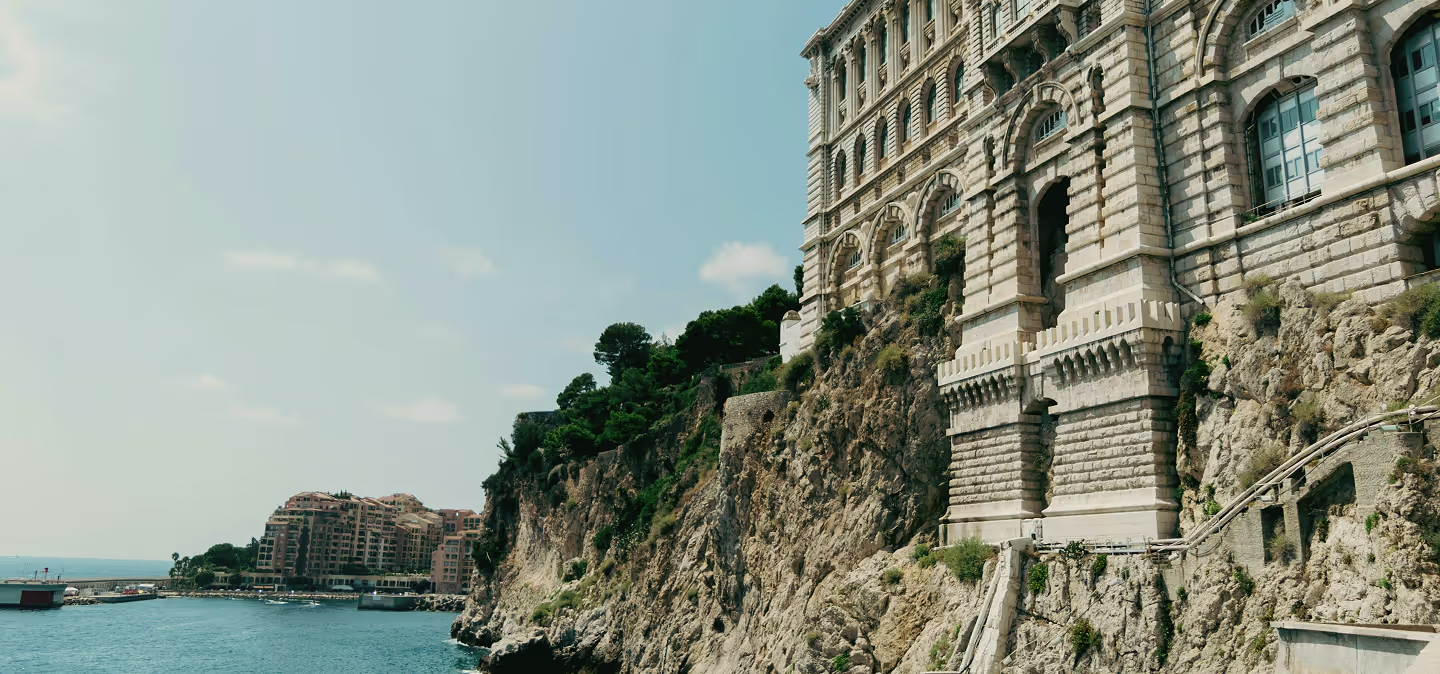
Guided tours, capacity, prices, refurbishment works and access: the complete guide to the Stade Louis II, the nine-arched landmark of the Fontvieille district.
Seen from the water, the Stade Louis II looks more like a palace than a sports ground. Its nine white arches, facing the harbour of Fontvieille, have become one of the most recognisable silhouettes in European sport. Behind that facade sits an extraordinary complex: a pitch laid over a four-level car park, an Olympic swimming pool open to the public, some thirty disciplines practised every week and a stadium built on land reclaimed from the Mediterranean. This guide covers everything you need to plan a visit: opening times, prices, capacity, stand layout, the ongoing refurbishment and how to get there from central Monaco.
The Stade Louis II at a glance: a stadium like no other in Europe
The Stade Louis II stands in Fontvieille, Monaco's newest district, built entirely on 22 hectares reclaimed from the sea between 1965 and 1971 at the initiative of Prince Rainier III. Construction of the stadium began in 1979 and finished in 1984. It was inaugurated on 25 January 1985 by Prince Rainier III, in the presence of Juan Antonio Samaranch, then president of the International Olympic Committee.
The princely brief was ambitious: a venue that blended into the district architecturally, made rational use of every square metre, used cutting-edge technology and, above all, served many sports rather than professional football alone. Forty years on, the wager still holds.
A few figures give the measure of the building: 210 metres long, 160 metres wide, 39 metres high, on a three-hectare footprint totalling 145,000 m² of built surface. It took 120,000 m³ of concrete and 9,000 tonnes of steel. The structure was engineered to withstand an earthquake measuring 8.3. Beneath the pitch, a four-level car park provides 1,260 spaces, a feat of urban planning in a country where every square metre counts.
The stadium is home to some forty sports associations, including the Monegasque Olympic Committee. Around 2,000 schoolchildren and more than 3,000 athletes use it every week. Internationally, it hosted the UEFA Super Cup every year from 1998 to 2012, a fixture that tied its image to Europe's biggest clubs.
What is the capacity of the Stade Louis II?
This is the most common question about the Louis II stadium, and the answer depends on the configuration. The venue's official figure is 17,715 seats for the multi-purpose stadium, while the capacity used for AS Monaco football matches is generally 16,360 once press, officials and safety areas are deducted.
The complex extends well beyond the pitch. The Salle Gaston Médecin, home of Monegasque basketball, seats up to 3,700. The aquatic centre has 500 seats and the school gymnasium 172. In other words, the Louis II can run several events in parallel under one roof.
That relatively modest capacity explains a much-discussed quirk: even when well filled, the stadium looks spacious, because the stands are wide and average league attendance stays below that of the big French grounds. The upside for spectators is real: almost every seat has a clear view, and the atmosphere concentrates naturally behind the goals.
Visiting the Stade Louis II: times, prices and what you see
Good news for the curious: the stadium is open to visitors, at a price that bears no relation to what you get to see. Guided tours last around an hour and run in French, English or Italian.
What does the guided tour cover?
The route takes you into areas normally closed to the public:
- the changing rooms where AS Monaco players prepare before kick-off
- the tunnel the teams walk through to reach the pitch
- the princely lounge, reserved for the Sovereign Family and official guests
- the Salle Gaston Médecin, the heart of Monegasque basketball
- the Albert II aquatic centre and its 50-metre Olympic pool
- the stands, with the view down over the pitch and the famous arches
The tour appeals as much to architecture enthusiasts as to football fans: fitting this many facilities into so tight a volume is genuinely spectacular.
Tour times and prices
Tours run Monday to Friday, excluding public holidays and event days, at five fixed times: 10.15am, 11.45am, 2pm, 3.30pm and 5pm. The tour season restarts each year in early spring, on 1 April for the 2026 edition.
Two caveats worth knowing. No tours run on football match days or on the day of the Herculis athletics meeting. On the afternoon before a match, the route is shortened: no players' changing rooms and no pitch access. On basketball days, the Salle Gaston Médecin is also removed from the circuit the evening before and on the day itself.
Do you need to book?
No, and that is exactly what catches visitors out. Tours cannot be booked online: you turn up at the relevant ticket office at least ten minutes before departure. Each group is capped at 30 people, which can be a problem in high season. Only groups of more than ten can request a quote and secure a slot in advance. Unaccompanied minors under 16 are not admitted.
♦ The concierge's tip
Aim for the 10.15am slot on a weekday. School groups tend to arrive mid-morning and in the afternoon, and since the cap is 30 people with no booking possible, the first departure of the day gives you the best chance of a small group. Check the fixture calendar before setting out too: the day before a match, the changing rooms and the pitch drop out of the route.
Watching an AS Monaco match at the Stade Louis II
Seeing AS Monaco at home remains the most powerful experience the stadium offers. The club plays in Ligue 1 and regularly hosts European fixtures, which turns certain autumn and winter evenings into occasions.
How to buy tickets
The official AS Monaco ticket office is the channel to use. Prices vary considerably with the opponent, the competition and the stand: a midweek mid-table fixture and a Champions League night are not sold at the same rate. The biggest matches sell out quickly, so booking several weeks ahead is wise. If you are staying at the Port Palace, facing Port Hercule, your concierge can help you secure seats before you arrive.
Choosing your stand: understanding the layout
The layout of the Stade Louis II is easy to picture. The two side stands run along the pitch and give the best reading of the game. Behind the goals, the ends gather the most vocal supporters and the noise. The stand on the arches side, at the end of the ground, is the one you see in every aerial photograph: it offers the most open view of the Rock of Monaco and the rooftops of Fontvieille.
One detail few guides mention: the athletics track around the pitch pushes the front rows slightly further from the action. For a football match, the raised rows of the side stands often give better sightlines than the first rows.
A match night at the Louis II? Sleep facing Port Hercule, one bus stop from the stadium.
Check availabilityThe Albert II aquatic centre and the other facilities
This is the lesser-known side of the Louis II: a large share of its facilities is open to the public, visitors included.
Swimming in the Olympic pool
The Albert II aquatic centre houses three pools: a 50-metre Olympic pool, a learner pool and a diving pit. A single entry costs 3.20 euros, a figure that is hard to believe in Monaco. The reduced rate of 1.90 euros applies to children under 12 and adults over 60, and under-twos enter free.
Watch the opening hours, which are limited and vary by day: the centre closes on Wednesdays, opens early on weekday mornings and switches to afternoon slots on Saturdays. Aquagym sessions and swimming lessons round out the offer, and the sauna is charged separately.
Weight room, squash and lesser-known disciplines
The stadium also has a weight room open on a per-session basis, four squash courts and a series of specialist halls: dojo, table tennis hall, boxing room, fencing hall, gymnastics hall, weightlifting room. More than thirty sports are practised there regularly, making the Louis II one of the densest multi-sport complexes in Europe relative to its size.
Where does the Stade Louis II refurbishment stand?
The subject comes up in every Monegasque conversation. In summer 2025, the Prince's Government launched the first phase of a modernisation programme covering the refreshment areas, the toilets and the stands. The stated aim is twofold: improve spectator comfort and bring the facilities up to the standard required for major international competitions.
The work is being carried out in phases between 2025 and 2027, precisely so the stadium can keep operating without interruption. AS Monaco home matches, the Herculis meeting and the Games of the Small States of Europe are all going ahead as normal. While work is under way, some facilities are relocated temporarily and alternative arrangements are put in place.
This first phase is only a beginning. It forms part of a wider modernisation plan for the Stade Louis II reaching towards 2035, whose final shape has yet to be confirmed. For visitors, the practical impact is limited: some areas may be temporarily inaccessible, and this is communicated before tour tickets are purchased.
☉ Good to know
The work being carried out between 2025 and 2027 may make some areas of the stadium temporarily inaccessible. This is communicated before tour tickets are purchased. AS Monaco matches, the Herculis meeting and the Games of the Small States of Europe are all going ahead as normal throughout the works.
How to reach the Stade Louis II from central Monaco
The stadium sits at 7 avenue des Castelans in Fontvieille, at the south-western tip of the Principality. From Port Hercule, allow around twenty minutes on foot along the seafront and via the public lifts, or five minutes by taxi.
The urban bus network is the simplest option: lines 4 and 6 serve the Stade Louis II stop. Line 6 is particularly handy, running from Fontvieille to Larvotto via Port Hercule and Place du Casino. From Monaco Monte-Carlo station, the stadium is reachable on foot, by bus or by taxi.
By car, the four-level Stade Louis II car park absorbs most of the traffic, but fills quickly on match nights. Our guide to parking in Monaco covers the alternatives nearby. If you are arriving from France or Italy, our article on how to get to Monaco compares train, car and air options.
A geographical curiosity: Monaco's heliport sits less than 400 metres from the stadium. Travellers arriving from Nice Côte d'Azur airport by helicopter therefore land a few steps from the arches, just seven minutes after take-off.
What to do around the Stade Louis II in Fontvieille
A stadium visit combines easily with half a day in the district. Fontvieille is flat, open and far quieter than Monte-Carlo, which makes it a pleasant stop, especially with children.
- The Prince of Monaco's Car Collection, a few minutes' walk away, gathers around a hundred exceptional vehicles. Our guide to the Monaco car museum covers the visit.
- The Princess Grace Rose Garden, with thousands of rose bushes, offers a rare green pause in the Principality.
- The port of Fontvieille and its promenade, more low-key than Port Hercule, with a handful of terraces favoured by residents.
- The Fontvieille shopping centre and its Saturday morning market, frequented mainly by Monegasques.
To explore the district in depth, see our complete guide to Fontvieille. And if you are travelling as a group, our selection of family activities in Monaco ties several of these addresses together.
Staying in Monaco: the Port Palace, between the harbour and the stadium
Set on the edge of Port Hercule, the Port Palace places guests midway between the historic heart of the Principality and Fontvieille. The stadium is around twenty minutes away on foot, or a direct bus ride on line 6, whose stop is a few steps from the hotel.
All 50 of our rooms and suites look out over the harbour and the Prince's Palace. Our guests benefit from a concierge service that can handle bookings, transfers and access to sporting events across the Principality. After a match, the restaurant La Môme, on the sixth floor of the hotel, extends the evening with an open view over the yachts and the Rock.
Port Palace Monaco
The harbour on one side, the Stade Louis II on the other
All 50 of our rooms and suites look out over Port Hercule and the Prince's Palace. The stadium is twenty minutes away on foot or a direct bus ride. Our guests benefit from a concierge service to arrange every detail of their stay, from transfers to access to sporting events across the Principality.
Book your stayFAQ: your questions about the Stade Louis II
Can you visit the Stade Louis II all year round?
No. Guided tours run from spring to autumn, Monday to Friday, excluding public holidays and event days. The 2026 season restarted on 1 April. Outside that period the stadium remains open for its public sports facilities, but not for guided tours.
What is the capacity of the Stade Louis II?
The official figure for the multi-purpose stadium is 17,715 seats. In football configuration, for AS Monaco matches, the capacity used is around 16,360. The Salle Gaston Médecin, dedicated to basketball, seats up to 3,700 spectators.
Why does the Stade Louis II often look half empty?
Monaco has fewer than 40,000 residents, a catchment far smaller than that of other Ligue 1 clubs. Average attendance reflects this, even though European fixtures and derbies draw a much wider crowd from across the French Riviera and Italy.
How much does a Stade Louis II tour cost?
Full admission is 5.80 euros and the reduced rate is 2.90 euros for children under 12, adults over 65 and groups of at least ten. Children under 5 enter free.
Can you swim in the Stade Louis II pool?
Yes. The Albert II aquatic centre is open to the public, with a 50-metre Olympic pool, a learner pool and a diving pit. A single entry costs 3.20 euros. The centre closes on Wednesdays and its hours vary by day, so check before setting out.
Who owns the Stade Louis II?
The stadium is owned by the Monegasque state. It falls under the Department of Education, Youth and Sport, not the football club, which is a tenant for its home fixtures.
A sporting landmark on a Monegasque scale
The Stade Louis II is not Europe's largest ground, and it was never meant to be. It is something else: a distillation of Monegasque ingenuity, stacking a Ligue 1 pitch, an Olympic pool, a EuroLeague arena and thirty-odd sports onto three hectares reclaimed from the sea. For six euros and an hour of your time, the tour is one of the best value discoveries in the Principality.
Whether you come for a match, for the guided tour or simply to photograph the arches at sunset, the stadium slots easily into a stay in Monaco. All that remains is choosing the harbour-view room that will serve as your base.
Practical information verified with the official Stade Louis II website and Visit Monaco. Prices and opening times are subject to change: please confirm before your visit.
